30 September 2026
Full-Duplex vs Half-Duplex: Why Intercom Beats Radio on a Live Show
A two-way radio lets one person speak at a time. Full-duplex intercom lets the whole crew talk and listen at once, with no button to press. On a live show, that difference is the difference between a cue made and a cue missed.
Half-duplex, or semi-duplex, is how a two-way radio works: one person holds the button and talks, and everyone else on that channel waits. Full-duplex is how a phone call works: everyone can talk and listen at the same time. Wired partyline, wireless beltpacks and matrix keypanels are all full-duplex. Radios are not.
On a radio, you press to talk and let go to listen. There is one voice on the channel at a time, everyone else waits their turn, and anything said while someone else is transmitting is lost. You have a hand on the radio, or a speaker microphone at the shoulder. On intercom there is no button: you talk and listen at the same time, everyone on the channel hears everyone, you can cut in the moment a cue needs it, nothing is lost while somebody else is talking, and your hands are free, on a headset, all day.
On a busy show that difference matters most at the moments when someone needs to cut in on a cue, because half-duplex makes them queue for it. Take three moments from any show night.
A cue is going out. On radio, the stage manager is mid-count and lighting needs to say the follow spot is not ready. They press to talk and hear the busy tone, or they talk over the count and nobody hears either. On intercom, lighting says "hold, spot two", the stage manager hears it under their own voice, and the count stops. Nobody pressed anything.
Two things happen at once. On radio, the director is talking to camera three while the floor manager has thirty seconds to go and cannot get on. Someone has to stop talking before the other can start. On intercom, the director keeps talking to camera three, the floor manager counts down on the same channel, and both are heard, each at their own level.
Something goes wrong. On radio, a fault is called, three people answer at once, none of them gets through, and the one who could fix it is still waiting for a gap. On intercom, the fault is called, the right person answers straight away, and the rest of the crew hears the answer without asking for it.
None of this means radios have no place. Two-way radios are simple, reliable and need no training: press the button, talk, release. They are the right tool where the message is short and the users are many: security, stewarding, parking, catering and site coordination. Nobody needs a headset to be told a gate is open. Full-duplex earns its keep where people work together in real time: production, stage management, lighting, cameras and audio. That is where waiting for a gap costs a cue.
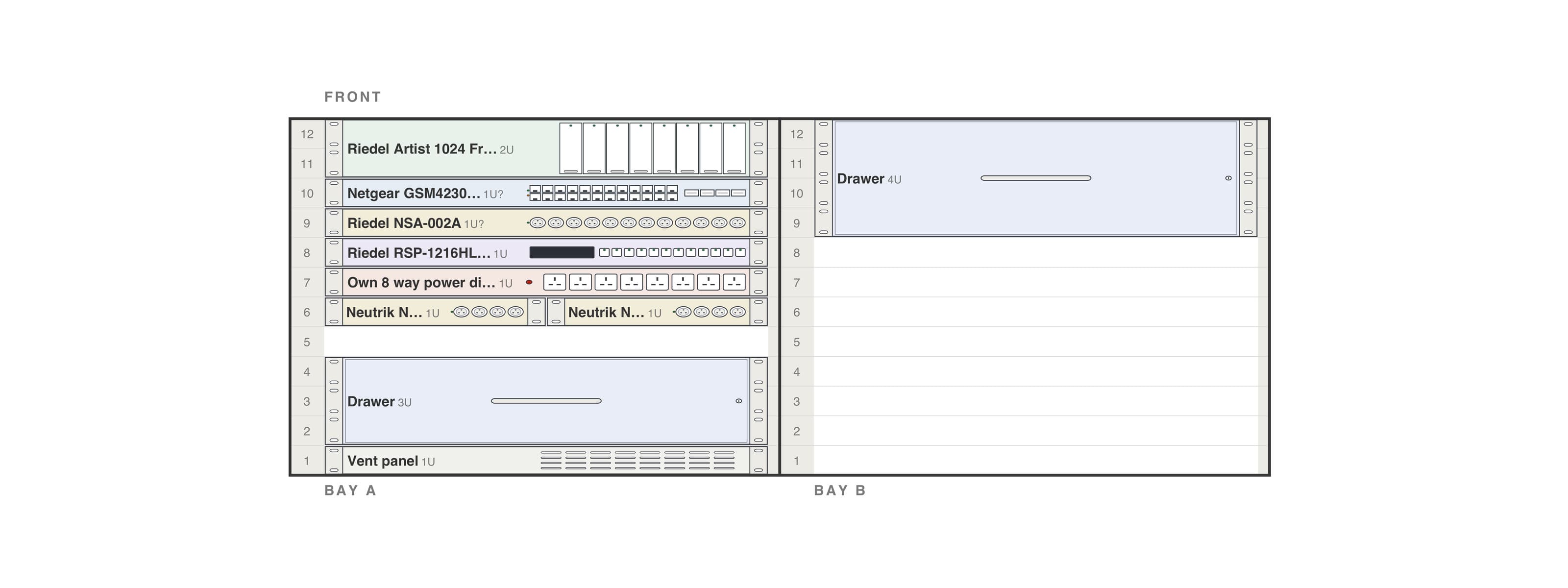
The two are not rivals either. On most of our jobs the radio fleet is tied into the intercom through a digital matrix, so security has its own clean channel and the stage manager can still reach them without picking up a radio. Wired keypanels at fixed positions, wireless beltpacks roaming, radios on the ground and remote sites over IP, all talking to each other.
That is what TOMCOMM designs and deploys: a complete communications network, full-duplex where it matters and radio where it fits, with no waiting, no bottlenecks and no missed cues. Every system we hire is in the catalogue at tomcomm.co.uk/hire, from Riedel Bolero, Clear-Com FreeSpeak and Green-GO wireless beltpacks to the Artist matrix that joins them and the Motorola radios for the ground crew. Tell us what you are planning and who needs to talk to whom, and we will put the right mix together for it.